

Ryan McManamay will be the sole TA for Ichthyology lab next spring. I would really like to hire someone who can help him with lab set up, clean up, teaching finer points during lab, and watching his back with 24 scalpel-holding students. If anyone has time and interest please let Ryan or me know soon.
Lab is 230-520pm Mondays and Wednesdays.
Monday, December 15, 2008


Monday, April 28, 2008
Fishing in The Rappahannock River
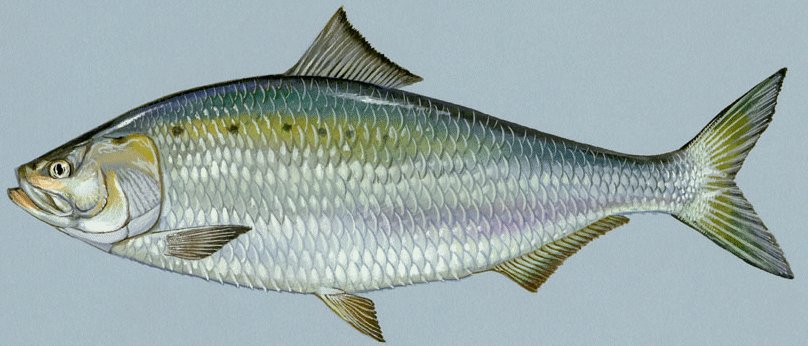

Fishing anytime from mid-March through May and you are likely to encounter these fish (pictured on bottom), which are anadromous.
averaging around 1 lb., with fish up to 2 lbs. Fish with light spin casting, using very small, brightly colored shad darts, spoons, jigs, or minnow imitation lures. Silver-sided with grayish-green back and a prominent dark spot, followed by a row of lighter spots (especially when fresh), on the upper part of the side just behind the gill cover; body long but compressed, asymmetrical top to bottom and in cross section it is wedge-shaped; the lower jaw protrudes significantly beyond the upper jaw when the mouth is closed. Each scale on the sides has a small dark spot.
If you are lucky you may even catch its larger cousin - in the same genus (picture on the top
Let's Go fishing for...

This fish is common in the South Holston Reservoir where it is currently making spawning runs upriver.
Name this minnow!

This is probably one of the easiest-to-identify of our native Cyprinids. The deep body, much upturned mouth and falcate anal fin are unique in this family as is the fleshy ridge between the pelvic fin and anus. It is very tolerant of high temperatures and most common in slack waters of rivers and in lakes. It is the most common bait minnow in our region
The ultimate stream fish colonizer


This fish is one of the first colonizers of disturbed stream habitats. It has a large mouth (reaching past the front of the eye) for a cyprinid and can live off a variety of food types, including terrestrials that fall in the stream. The distinguishing characteristic is the large mouth and the large black spot at the origin of the dorsal fin. Males and females will often look different from the same water body -- there is a black caudal spot that is common in all but the larger individuals. IN preparation for spawning the male digs a pit in the stream bottom by removing mouthfuls of gravels and then stands guard hoping to attract females. This species also has a small flap like barbel in the groove above the corner of the mouth (it is observable in the drawing on the left). HINT: World Record Bass was caught June 2, 1932 on a lure named after this fish.
Thursday, April 24, 2008
Bait fish? I don't think so.


So maybe your tendency is to call these bait fish - they all the same. Truth is, there as different as a human and a chimpanzee. Of course, you're thankful because your TA for ichthyology only requires you to know the genus. So what's the genus.
Is this a new record


An angler recently caught a catfish from the james river that looks just like this photo (just much much larger). The fish weighed 59 pounds and he wants to know if this is a new state or world record catfish. Who wants to be an ichthyologist and confirm the identification? What species is this? Is it a new state record for the species?
Subscribe to:
Posts (Atom)